AACSB standards constitute a comprehensive framework for evaluating the quality of business schools and faculties offering education in management and economics. They encompass institutional strategy and governance, educational quality, faculty development, research activity, and societal impact. Their purpose is to ensure alignment between the institution’s mission and its activities, while fostering a culture of continuous improvement. Meeting these standards requires a systematic approach, measurable outcomes, and transparent processes.
History and Evolution of AACSB Standards
AACSB standards have a history spanning more than a century and have served from the outset as a framework for ensuring quality in business education. The organization was founded in 1916 as the American Assembly of Collegiate Schools of Business, and as early as 1919 it began granting the first accreditations based on formally established quality criteria. This marked one of the earliest structured systems of evaluating business schools worldwide.
Over the following decades, the standards evolved significantly. Initially, they focused primarily on quantitative requirements, such as curriculum structure and faculty qualifications. In the 1980s and 1990s, greater emphasis was placed on a mission-driven approach, strategic alignment, and a culture of continuous improvement. This shift represented a move away from rigid formal requirements toward a more comprehensive evaluation of institutional effectiveness.
In 2001, the organization adopted the name AACSB International, highlighting its expanding global reach and influence beyond the United States. A major milestone followed with the 2020 standards revision, which strengthened the outcomes-based approach, emphasized measurable impact, and reinforced the integration of strategy, educational quality, and research performance.
In April 2026, AACSB formally approved the new Global Standards for Business Education™, which came into effect on 1 July 2026. Building on the 2020 accreditation standards, the revised framework places greater emphasis on measurable impact, learner success, strategic management, and continuous improvement. A transition period allows institutions to adapt to the new requirements.
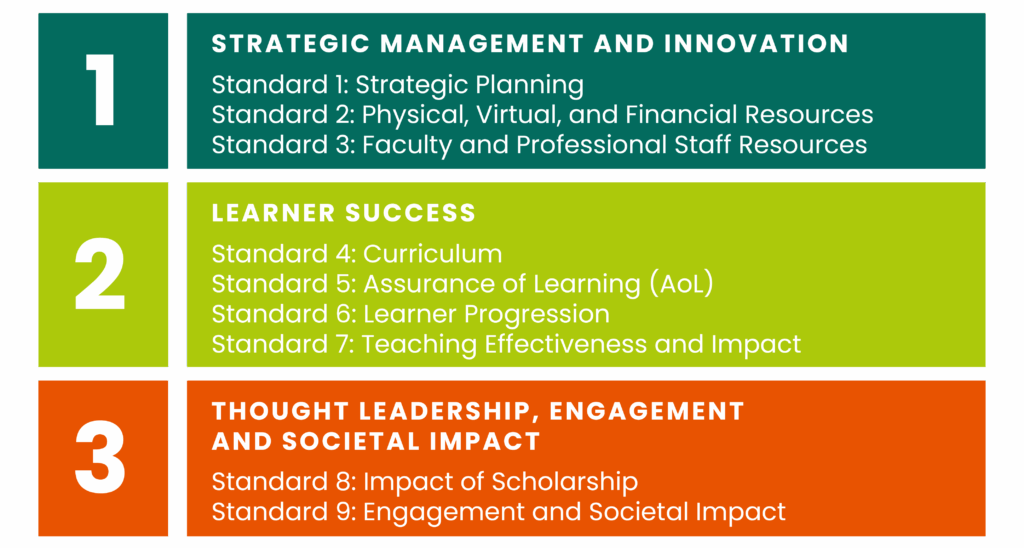
The 2020 AACSB Business Accreditation Standards are organized into nine standards across three interconnected areas: Strategic Management and Innovation, Learner Success, and Thought Leadership, Engagement, and Societal Impact. Together, they provide a comprehensive framework for institutional quality, continuous improvement, and meaningful societal impact.

Standard 1: Strategic Planning
This standard focuses on the alignment of an institution’s mission, strategic goals, and activities. It emphasizes effective strategic planning, stakeholder engagement, innovation, and continuous improvement, ensuring that institutional development contributes to long-term success and positive societal impact.
Standard 2: Physical, Virtual, and Financial Resources
This standard addresses the availability and effective management of resources necessary to support the institution’s mission. It emphasizes adequate infrastructure, technological capabilities, and financial sustainability to ensure high-quality education, research, and institutional development.
Standard 3: Faculty and Professional Staff Resources
This standard focuses on the qualifications, competencies, and professional development of academic and administrative staff. It emphasizes maintaining sufficient and appropriately qualified personnel to support high-quality teaching, impactful research, and the institution’s strategic objectives.

Standard 4: Curriculum
This standard ensures that educational programmes are relevant, up-to-date, and aligned with the institution’s mission and the evolving needs of business and society. It emphasizes the development of essential knowledge, skills, and competencies through innovative teaching approaches and engagement with professional practice.
Standard 5: Assurance of Learning
This standard focuses on systematically assessing whether students achieve the intended learning outcomes of their programmes. It requires institutions to use assessment results to identify areas for improvement and continuously enhance the quality and effectiveness of education.
Standard 6: Learner Progression
This standard addresses the institution’s responsibility to support students throughout their educational journey, from admission to graduation and beyond. It emphasizes monitoring student progression, providing appropriate academic and career support, and promoting successful educational and professional outcomes.
Standard 7: Teaching Effectiveness and Impact
This standard emphasizes the quality and effectiveness of teaching and its contribution to student learning. It requires institutions to evaluate teaching performance, support faculty development, and promote innovative educational practices that enhance the learning experience.

Standard 8: Impact of Scholarship
This standard focuses on the production and dissemination of high-quality research and other intellectual contributions. It emphasizes the relevance and impact of scholarly activities on the advancement of knowledge, business practice, public policy, and society.
Standard 9: Engagement and Societal Impact
This standard emphasizes the institution’s active engagement with business, public institutions, and wider society. It requires institutions to demonstrate how their educational, research, and collaborative activities contribute to meaningful and positive societal impact, consistent with their mission and strategic priorities.