AACSB accreditation is a comprehensive, internationally recognized process designed to evaluate and continuously enhance the quality of business education. It is based on a mission-driven approach that considers each institution’s strategic priorities, educational activities, research performance, and engagement with society.
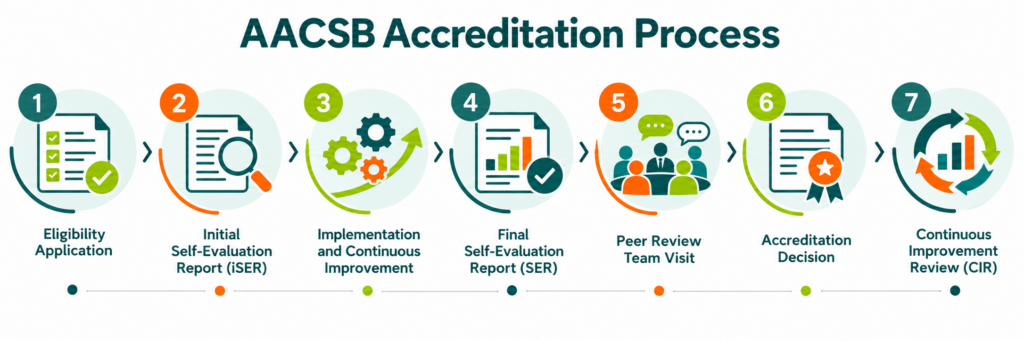
The accreditation process involves several interconnected stages, including institutional self-assessment, strategic planning, implementation of improvements, preparation of accreditation reports, and an independent review conducted by experienced representatives of AACSB-accredited institutions. Its primary objective is not only to verify compliance with accreditation standards but also to foster a lasting culture of quality, innovation, and continuous improvement.
1. Eligibility Application
The process begins with the institution becoming an AACSB educational member and submitting an eligibility application. This application provides essential information about the institution, its mission, organizational structure, degree programmes, and strategic priorities.
AACSB evaluates whether the institution meets the eligibility requirements and is prepared to undertake the accreditation process.

2. Initial Self-Evaluation Report (iSER)
Following acceptance into the accreditation process, the institution prepares an Initial Self-Evaluation Report (iSER), with guidance from an AACSB-appointed mentor.
The report assesses the institution’s alignment with AACSB standards, identifies areas requiring improvement, and outlines an action plan for achieving the expected quality standards.
3. Implementation and Continuous Improvement
At this stage, the institution implements its strategic improvement plan and systematically monitors progress toward meeting AACSB standards.
Particular attention is given to strategic management, faculty qualifications and development, curriculum quality, Assurance of Learning (AoL), research impact, and engagement with the wider community.
Progress is documented through reports submitted to AACSB, demonstrating institutional development and the effectiveness of implemented improvements.

4. Final Self-Evaluation Report (SER)
Once the institution has demonstrated sufficient progress, it prepares a Final Self-Evaluation Report (SER).
This comprehensive document presents evidence of alignment with AACSB standards, describes improvements implemented throughout the accreditation process, and demonstrates the institution’s achievements in education, research, strategic management, and societal impact.
The report serves as a key reference document for the subsequent external evaluation.
5. Peer Review Team Visit
One of the most important stages of the accreditation process is the on-site visit conducted by an international Peer Review Team (PRT) composed of experienced representatives of AACSB-accredited institutions.
During the visit, the team examines institutional documentation, meets with university leadership, academic and administrative staff, students, alumni, and external stakeholders, and evaluates the practical implementation of AACSB standards.
The visit provides an opportunity to verify the information presented in the Self-Evaluation Report and assess the institution’s commitment to quality assurance and continuous improvement.

6. Accreditation Decision
Following the visit, the Peer Review Team prepares an evaluation report containing its findings and recommendations.
The report is reviewed through AACSB’s accreditation governance process, including the relevant accreditation committee and, where applicable, the AACSB Board of Directors.
The outcome may include accreditation, deferral of the decision pending further improvements, or denial of accreditation.
7. Continuous Improvement Review
Achieving AACSB accreditation does not mark the end of the quality assurance process.
Accredited institutions are expected to maintain alignment with AACSB standards, demonstrate continuous improvement, and regularly evaluate the effectiveness of their educational, research, and strategic activities.
Under the current AACSB framework, accredited institutions undergo a Continuous Improvement Review (CIR) every six years. This periodic evaluation supports the long-term sustainability of educational quality and institutional development.